

Java Course in Ahmedabad

Best Java Course in Ahmedabad for Student & Professionals. Live Project Training & 100% Job Placement

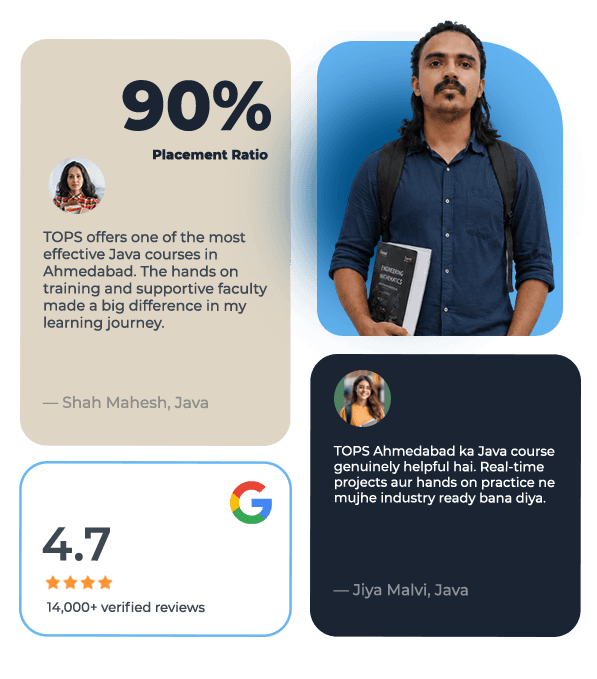
4.5 (1038)
View Reviews
4.7 (312)
View Reviews

Certificate Partner(s): NSDC/Skill India

Certificate Partner Logo
  • Hands on Training
  • Flexible Timings
  • Industry Based Training
  • Expert Trainer
  • Affordable Fees
  • Placement Opportunities

Attend a Free Demo

Fill the details and we will call you for further guidance

Java Course in Ahmedabad Icon

Our Facts and Figures

1 Lac+

Student Placed

3000+

Companies TieUp

19+

Offices in India

50+

Industry Courses

Get 100% Job Assistance by enrolling in Certified Java Training Course

Job Assistance
3000+ Companies Tie-Ups

Enter Your Details Now

Key Highlights

Limited Students Batch
Personalised Attention
Highly Qualified Teachers
Flexible Batch Timings
Interactive Learning
Live Projects
Career Support
Job Oriented Training

Java Course Highlights

Java Course in Ahmedabad — 100% Placement Assistance + Live Projects

The Java Course in Ahmedabad at TOPS Technologies is a practical, job-focused program that trains you to become a confident Java developer with strong fundamentals and real project exposure. From the first week you start writing code, working on assignments, and preparing for interviews, all backed by 100% Placement Assistance in one of Gujarat’s biggest IT hubs. To explore the city and its tech ecosystem, you can also visit Wikipedia.

TOPS Technologies has 4 training centers in Ahmedabad — CG Road, SG Road, Nikol, and Maninagar — making access easy for students across the city.

Why Choose TOPS for Java Training in Ahmedabad?

  • Structured, industry-aligned syllabus that takes you from absolute basics to frameworks used in production Java training in Ahmedabad companies.
  • 100% Placement Assistance with a dedicated in-house team connecting you to IT firms, startups, and product companies.
  • Live project-based learning so your Java coaching near me search converts into hands-on experience with real-world code.
  • Experienced trainers from industry who have worked on enterprise Java, APIs, microservices, and cloud deployments.
  • Flexible batches for college students, working professionals, and career switchers.
  • Regular tests, code reviews, mock interviews, and career guidance to help you compete for Java developer roles confidently.

Why This Java Course in Ahmedabad?

Ahmedabad has quickly developed into a strong IT and startup corridor, with companies building banking solutions, e-commerce platforms, ERP products, and SaaS tools using Java as a core backend language. Enrolling in the Java Course in Ahmedabad ensures that you learn skills that are directly mapped to these local opportunities.

The course is ideal for learners who searched for java course in ahmedabad, java classes near me, or java course classes near me and now want a structured plan to move from zero programming knowledge to job-ready skills.

Job Opportunities for Java Developers in Ahmedabad

Companies in Ahmedabad hire Java developers for roles ranging from trainee positions to mid-level backend engineering. IT service providers, product companies, consulting firms, and digital agencies all rely on Java for building secure, scalable applications.

Freshers typically start with packages in the ₹3 LPA to ₹4.5 LPA range, depending on skills, communication, and project experience.

Job Designations After Completing the Java Course

  • Java Developer
  • Backend Developer
  • Full Stack Java Developer
  • J2EE Developer
  • Software Engineer (Java)
  • Spring Boot Developer
  • API Integration Engineer
  • Support & Maintenance Engineer

Who Can Enroll in the Java Course in Ahmedabad?

  • Freshers
  • Graduates
  • Students
  • Working professionals
  • Career switchers

What to Expect from the Java Training

The Java Course in Ahmedabad is designed to simulate the workflow of real developers through practical coding exercises, assignments, and project work.

  • Core Java fundamentals
  • Object-oriented programming
  • Collections & multithreading
  • JDBC database connectivity
  • Servlets & JSP web development
  • Spring & Spring Boot introduction
  • Git, IDEs, and deployment basics
  • Resume & mock interview preparation

Curriculum Overview – From Core Concepts to Frameworks

  • Module 1: Programming fundamentals & Core Java
  • Module 2: OOP in Java
  • Module 3: Collections, Generics & Exceptions
  • Module 4: File I/O, Threads & JDBC
  • Module 5: Servlets & JSP
  • Module 6: Spring & Spring Boot
  • Module 7: Tools, testing & deployment
  • Module 8: Capstone project & interview prep

Placement & Career Support

  • Placement Cell: View Details
  • JobFest hiring events: Learn More
  • CareerFest / Campus Drive: Participate
  • Resume-building & interview prep
  • Mock technical & HR interviews

Student Testimonials

“I was searching for java course in ahmedabad and found TOPS. The mentors helped me complete my projects and get placed.”

“One of the best java classes with actual coding practice and project exposure.”

“Weekend java certification training batches were perfect for my schedule.”

“I searched for java classes near me and TOPS was the right choice.”

“The java coaching near me options were many, but TOPS felt the most professional.”

Local Centers — Train at the nearest TOPS Technologies centre

TOPS Technologies CG Road

Address: TOPS House, 2, Chimanlal Girdharlal Rd, Shanti Sadan Society, Ellisbridge, Ahmedabad, Gujarat 380006

Phone: +919974755006

TOPS Technologies SG Road

Address: 102, Baleshwar Square, Iskcon Cross Rd, Sarkhej - Gandhinagar Hwy, opposite Iskcon Mandir, Ahmedabad, Gujarat 380015

Phone: +919904422211

TOPS Technologies Maninagar

Address: 401, Amruta Arcade, Maninagar Char Rasta, Lala Lajpat Rai Marg, Maninagar, Ahmedabad, Gujarat 380008

Phone: +919974863333

TOPS Technologies Nikol

Address: 401, TOPS Technologies, Hilltown Landmark, Nikol Canal Rd, Opp. Das Khaman, Nikol, Ahmedabad, Gujarat 380049

Phone: +917624007666

Other Local Insights – Learning Java in Ahmedabad

Ahmedabad students prefer practical training, flexible timings, and placement-focused programs. TOPS Technologies provides structured mentoring, assignments, lab practice, and 100% Placement Assistance.

Take the Next Step with the Java Course in Ahmedabad

Start your journey today with industry-recognized training, real-world projects, mock interviews, and placement support.

Advanced Course Insights – Why Java Skills Stay Relevant

Java continues to power enterprise systems, banking platforms, backend services, Android servers, and cloud-native architectures. Its stability, performance, and rich ecosystem make it one of the strongest career choices for freshers and professionals.

See More

40%

Average Salary Hike

4.5 Lacs

Highest Salary

3000+

Hiring Partners

Join Our Free Upcoming Webinar

Java Course Curriculum

Download Curriculum

  • Introduction to Java
  • Introduction of Students Career in IT
  • Working on Project and Assignment Using Lab

  • Conditional Statements (If, If Else, Nested If Else If) (Switch Case)
  • Loops (While, Do While, For)
  • Break and Continue
  • SDLC Process
  • Project Analysis
  • Analysis In Details
  • DFD(with practical)
  • Introduction of DFD
  • Rules for Drawing DFD
  • Context Level
  • First Level
  • Second Level
  • Data Dictionary
  • Flow Chart
  • Data Dictionary
  • Flow Chart

  • Introduction of Core Java
  • Eclipse IDE
  • JVM,JDK,JRE
  • Class, Object, Method
  • Constructor
  • Garbage Collection
  • Finalize
  • Source File Layout
  • Package Management
  • Import Statement
  • Data types
  • Primitive Types
  • Reference Types
  • Modifiers- Public, Private, Protected, Default
  • Conditional Statements and Looping Statements
  • Array Introduction
  • Why Array? Advantages
  • Types of Array
  • Resizing Array
  • Copying Array
  • Primitive types and Reference type Arrays
  • Encapsulations
  • Inheritance – Introduction
  • Advantages of Inheritance
  • Types of Inheritance
  • Practical of Inheritance
  • Practical of Inheritance with Constructor
  • Polymorphism
  • Types of Polymorphism
  • Method Overloading and Method Overriding
  • Abstract and Interface – Introduction and Difference
  • Keywords – This, Static, Final, Super
  • Classes
  • Object Class(only Important Methods)
  • String Class (Only Important Methods)
  • String Buffer & String Builder
  • Wrapper Classes
  • Exceptions
  • Introduction – Why Exceptions
  • Types of Exceptions
  • Try catch and Finally Block
  • Multi-catch Exceptions
  • Throw and Throws keywords
  • Method Overriding with Exceptions
  • Custom Exceptions
  • FILE I/O
  • What is Stream and Types of Stream
  • File Input Output Streams and Its Methods
  • File class
  • Command Line Arguments
  • Thread-Introduction
  • Thread Life Cycle
  • Creating Threads
  • Thread Class Methods (Only Important Methods)
  • Runnable Interface
  • Synchronized block and Synchronized Methods
  • Collection Framework – Introduction
  • Collection API
  • Hierarchy of Collections
  • List and Set and Map Collections
  • Array list, vector, and Other Classes
  • Generics
  • Comparator and Comparables
  • JAVA GUI
  • AWT (Introduction only) & Swing (in Details)
  • Components, Containers, Frame, Window, Panel, Layout
  • All Components
  • Events, Event Handling

  • Database
  • DDMS and RDBMS
  • Introduction
  • MYSQL
  • MYSQL IDE
  • Query Types
  • DDL,DML,DQL, DCL
  • Constraints
  • Primary Key
  • Foreign Key
  • Unique Key
  • Normalizations
  • 1NF
  • 2NF
  • 3NF
  • Joins
  • All Joins Types
  • Advance Database
  • Indexers
  • Views
  • Procedures
  • Functions
  • Cursor
  • Triggers
  • JDBC (Insert, Update, Select, Delete)
  • Introduction of JDBC
  • Driver Types
  • Steps for Creating Connections
  • Types of Statements (Statements, prepared Statements and Callable Statements)
  • Result Set Interface
  • Database Metadata
  • Result Set Metadata

  • HTML
  • UL Tag
  • LI Tag
  • a Tag
  • IMG tag
  • Table, TR, TD tag
  • Form tags with Attributes
  • All input tags
  • CSS
  • Types of CSS
  • Pseudo- Classes
  • Margins and Puddings
  • CSS background
  • CSS using ID and Class
  • JavaScript
  • Events
  • Validations
  • Validations with Regular Expressions
  • Firebug
  • Template Integration
  • Introduction of Client-Server Architecture
  • HTTP Protocol overview with Request and Response header explanation
  • J2EE Architecture Overview
  • Web Component Development In Java
  • CGI Programming Process Advantage and Disadvantage
  • Servlet Programming Introductions
  • Advantage and Disadvantage
  • Servlet Versions
  • Types of Servlets
  • Difference between HTTP Servlet a Generic Servlet
  • Servlet Life Cycle
  • Creating Servlets
  • Servlet Entry in web.xml
  • Logical URL
  • Servlet Config Interface
  • Request Dispatcher Interface
  • Forward and Include Methods
  • Servlet Context Interface
  • Web Application Listener
  • Scope of Objects, Request, and Response
  • Application (Context) , Config
  • Java Filters – Introduction
  • What are the needs
  • Filter Life Cycle
  • Process of Execution Filter
  • Applying Filter
  • Entry in web.xml
  • URL Pattern with Filter
  • JSP Introduction
  • JSP Translation
  • JSP Life Cycle
  • Comments
  • Directives
  • Scrip lets
  • Expression
  • Declaration
  • Implicit Objects
  • Action
  • JSTL
  • Custom Tags

  • Session Management – Introduction
  • What are the needs?
  • Session Tracking Technique
  • Hidden Form Fields
  • URL Rewriting
  • Cookies
  • Session
  • Design Pattern
  • MVC Design Pattern with Example
  • AJAX Programming With Example
  • Introduction to Distributed Technologies
  • RMI, EJB and WEB Services Introduction
  • Types of web services
  • What is Restful Web Services?
  • Restful Web Services Annotations
  • Restful Web Services with Example

  • Hibernate Introduction
  • Hibernate Architecture
  • Hibernate Configuration
  • All Core Interface
  • Query and Criteria
  • Named Query
  • All Relationships
  • One to One
  • One to Many
  • Many to One
  • Many to Many
  • All Database Operations with hibernate

  • Overview Of Spring Framework
  • Introduction of Spring Framework Architecture
  • Core Container
  • AOP (Aspect Oriented Programming)
  • Spring DAO (Data Integration)
  • Web
  • Spring Using IDE
  • Using Library
  • Spring Hello World Example
  • Spring IOC Container
  • Bean Factory
  • Application Context
  • Spring Bean Definition
  • Configuration
  • Life Cycle
  • Inheritance
  • Scopes
  • Spring Dependency Injection
  • Constructor-based
  • Setter Getter based
  • Inner Beans, Aliases, and ID-ref
  • Collections and References
  • Auto Wiring
  • Spring AOP
  • AOP Term
  • Write the Aspects
  • Configure Where the Aspects
  • Spring ORM
  • Spring MVC Web Forms
  • Spring Form Handling
  • Spring Form Tags
  • Spring Controller XML and Annotation Based
  • Spring MVC with Session Management
  • Spring CRUD Operation using Hibernate ORM

  • Cloud Computing – Introduction
  • Types
  • Hosting

  • The Project Definition for this Java Live Project was an Online News Portal. It allows the News publisher to publish his news and the user can select the news he wants to read. The project was developed using cutting edge technology in Java using advance

  • This Live project was rated as the best java project ideas was built in Java and allows a user to find cheap and efficient parking in and around where the user is. The system using gps tracking on the mobile phone and finds the most effective parking spot

  • This Java Project was built for the government java course admission process. The student Management system allows the tracking of all the students, their daily attendance, Java Classes, Java Certification grades. All the information about Java Training i

Attend a Free Demo

Fill the details and we will call you for further guidance

Java Course in Ahmedabad Icon

Course Key Features

Master Core Java Programming Concepts
Get hands on with Servlets and JSP Technologies
Create applications with Spring And hibernate
Key Feature Icon

Skills Covered

Core Java
JSP
Servlet
MVC
MySQL
JavaScript
Spring
Hibernate
API
JSON
XML
Jquery
Skills Icon

Job Roles

Java Developer
Spring Developer
Software Developer
Software Programmer
Backend Developer
Tools Icon

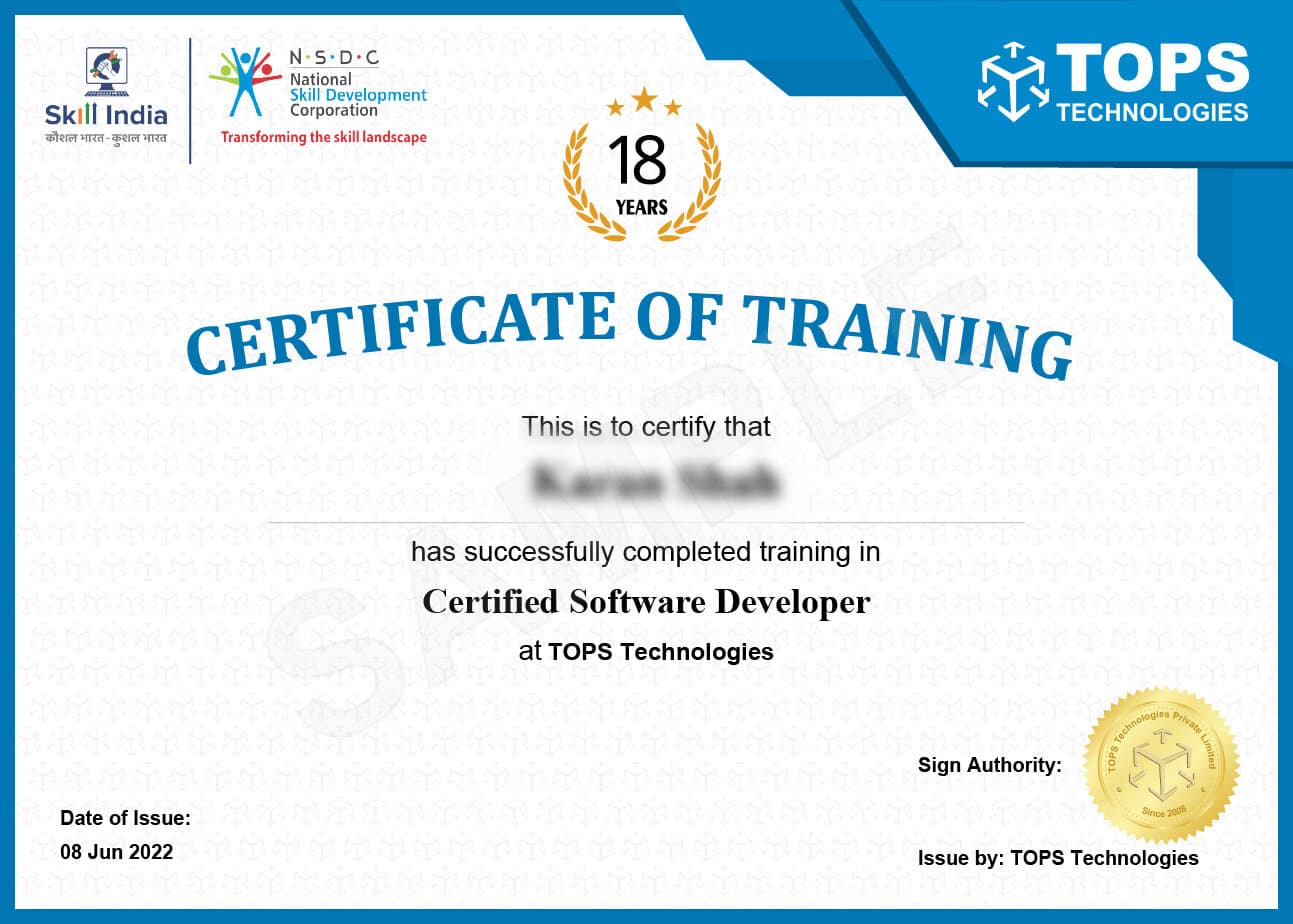
Get Training Certificate by Government
Recognized NSDC/Skill India

Certificate Demo Image
  • National Skill Development Corporation
  • Supported by the vision of PM Shri Narendra Modi
  • Certification by NSDC SkillIndia
  • Valid for all Jobs and College Training
  • International Recognition
Certificate Demo Image

Student Reviews

FAQ

Yes, TOPS Technologies offers Java Live Project Training in Ahmedabad. Our experienced trainers will teach you the basics of this popular programming language so that you can create effective and efficient applications. You will also learn to use various Java libraries and frameworks to build more complex applications. This Java Training in Ahmedabad is perfect for anyone who wants to learn Java in a hands-on environment.

Finding Java jobs in Ahmedabad can be daunting, but it is possible with the right strategy. Here are some tips on how to land a job: 

One approach is to search for job postings on websites. These can typically list new job openings first, so it is important to check back frequently. Additionally, it can be helpful to subscribe to job alerts from companies you are interested in working for. This will help you stay up-to-date on new opportunities as they arise.

Another option is to attend career fairs and meetups related to Java. This can be an effective way to network and learn about potential employers. It is also important to keep in mind that not all companies require experience in Java, so it's worth researching which types of positions are available before attending a meeting.

Finally, researching Java programming languages and frameworks is always a good idea before applying for jobs. This information can help you demonstrate your skills and highlight gaps in your knowledge. Doing this research will increase your chances of landing an interview and, potentially, a job offer.

If you have a Java certification from a reputed institute it helps you in showcasing your skills to your employers. Enroll in our Java Training In Ahmedabad at TOPS Technologies and learn everything you need to know to start your career in this field. 

The Java Course Fees in Ahmedabad will vary from one institution to another depending on the program's length and the institution that will be delivering the program. The course fees might range anywhere from a few thousand rupees to a few lakhs.

If you want to learn Java, look no further than TOPS Technologies. Our Java Institute in Ahmedabad offers Java Computer Courses to help you build your career in this field.

Yes, TOPS Technologies offers Java courses with placement assistance in Ahmedabad. The course is designed for students who want to learn Java and gain experience in the software development industry. The course has a placement assistance program that guarantees placements for students in leading companies.

Recent research and estimates suggest that a Java Developer's annual salary in Ahmedabad may go up to 7 Lakhs Indian Rupees (INR). But the pay scale may change depending on the individual's experience and skills.

Doing a Course from a Java Training Institute like TOPS Technologies can be a good way to secure your future in this field and increase your chances of getting a high-paying job.


Yes, TOPS Technologies offers Java Interview Preparation for Freshers in Ahmedabad. We understand that preparation for the Java interviews is crucial and that you need the best possible preparation to ace them. That's why we offer our preparatory services to help you achieve this. TOPS Technologies is considered the Best Java Training Institute in Ahmedabad. It has a team of experts with years of experience in preparing students for Java interviews, and they will use their knowledge to help you improve your skills and prepare for the toughest Java interviews.

We believe that every student is unique, and therefore, each of them needs a different approach when preparing for the Java interview. That's why we offer tailor-made training programs that are based on your strengths and weaknesses so that you can get the most out of our preparatory services.

So if you're looking to improve your chances of getting a good job in the IT sector, don't miss out on our top-notch Java interview preparation at TOPS Technologies.

The skills you need to become a Java developer vary depending on your experience level and where you are starting from. However, most developers typically need some coding experience, as well as an understanding of object-oriented design principles and the basics of the Java language. 

Here is a list of some common skills that every Java developer should have:

Coding Experience: Ideally, developers should have some coding experience before working on Java projects. This can come from years of programming in another language or taking a few introductory coding courses.

Object-Oriented Design Principles: Developers need to understand how objects work and how to create code that is easy to read and maintain. They should also be familiar with common design patterns and know how to use inheritance when needed.

Understanding of the Java language: A deep knowledge of the Java language is essential for many Java development tasks. Developers need to read code quickly and understand what's happening under the hood. They also need to be able to find solutions to common problems by using the Javadoc toolkit and the JDK APIs.

If you're interested in learning Java, and want to start your career with this amazing programming language, then you should definitely enroll in our top-rated Java Classes in Ahmedabad at TOPS Technologies. With our courses, you'll be able to learn everything there is to know about Java, and start building powerful applications right away.

The JVM is a crucial part of Java’s architecture. It interprets the compiled Java bytecode and translates it into machine code specific to the underlying operating system and hardware. This enables Java applications to be platform-independent. JVM also manages system memory, garbage collection, and provides security and exception handling.


  • JRE (Java Runtime Environment): A package containing the JVM and essential libraries required to run Java applications. It is meant for end-users.
  • JDK (Java Development Kit): A superset of JRE that includes development tools like the Java compiler (javac), debugger, and documentation tools. It is used by developers to create Java applications.

Bytecode is the intermediate, low-level code generated by the Java compiler from your source code. This bytecode is platform-independent and is executed by the JVM on any platform. Bytecode is the key reason why Java is considered a platform-independent language.

Interview Questions

 Garbage collection automatically deallocates memory by removing unused objects. It helps prevent memory leaks.

Java is always pass-by-value. For objects, the reference is passed by value, meaning changes inside the method affect the object but not the reference itself.

Polymorphism means “many forms”. It allows methods to perform different tasks based on the object or data type:

  • Compile-time polymorphism: Method overloading.
  • Runtime polymorphism: Method overriding.


Multithreading allows multiple threads to run concurrently. Implemented by:

  • Extending Thread class.
  • Implementing Runnable interface.

Java's object-oriented structure, simplicity, and robust features like multithreading, automatic memory management, and high security make it ideal for developing mobile apps, enterprise systems, cloud-based solutions, and IoT applications.


Object-oriented programming (OOP) is a programming paradigm that organizes code into reusable units called "objects." It's built upon key principles like encapsulation, abstraction, inheritance, and polymorphism, which facilitate modular, maintainable, and flexible software development. 


  • Inheritance allows a class (subclass or derived class) to inherit properties and behaviors (fields and methods) from another class (superclass or base class).
  • It promotes code reusability and establishes an "is-a" relationship between classes. 

Polymorphism means "many forms". In Java, it allows objects of different classes to be treated as objects of a common type (e.g., through inheritance or interfaces). 

Example: Method overriding is a form of polymorphism. A subclass can redefine a method inherited from its superclass to provide specific behavior. 


The JVM is a virtual machine that provides a runtime environment for executing Java bytecode. It translates bytecode into machine-specific code for the underlying operating system and hardware. 

It's responsible for memory management (garbage collection), thread management, and other runtime operations. 


Wrapper classes (e.g., Integer, Double, Boolean) convert primitive types to objects and provide utility methods. Useful in collections and autoboxing.


Latest Blogs