

Software Testing Course in Ahmedabad

Learn Software Testing with Best Software Testing Course and Training Institute & Become an Expert QA, Tester

4.5 (1038)
View Reviews
4.7 (312)
View Reviews

Certificate Partner(s): NSDC/Skill India

Certificate Partner Logo
  • Hands on Training
  • Flexible Timings
  • Industry Based Training
  • Expert Trainer
  • Affordable Fees
  • Placement Opportunities

Attend a Free Demo

Fill the details and we will call you for further guidance

Software Testing Course in Ahmedabad Icon

Our Facts and Figures

1 Lac+

Student Placed

3000+

Companies TieUp

19+

Offices in India

50+

Industry Courses

Get 100% Job Assistance by enrolling in Certified Software Testing Training Course

Job Assistance
3000+ Companies Tie-Ups

Enter Your Details Now

Key Highlights

Limited Students Batch
Personalised Attention
Highly Qualified Teachers
Flexible Batch Timings
Interactive Learning
Live Projects
Career Support
Job Oriented Training

Software Testing Course Highlights

Software Testing Course in Ahmedabad — 100% Placement Assistance + Live Projects

The Software Testing Course in Ahmedabad at TOPS Technologies is designed for students and professionals who want to build a strong career in quality assurance and software testing. This industry-focused training includes practical exposure, live projects, and 100% Placement Assistance to help you succeed in Ahmedabad’s growing IT ecosystem. Learn in a city known for education and technology growth — Wikipedia.

TOPS Technologies has 4 training centers in Ahmedabad — CG Road, SG Road, Nikol, and Maninagar — making access easy for students across the city.

Why Choose TOPS Technologies?

  • 100% Placement Assistance with dedicated career support
  • Hands-on live project training on real testing scenarios
  • Flexible batch timings for students and working professionals
  • Industry-expert trainers with real QA experience
  • Global certification guidance and exam preparation
  • Career counseling, resume building & mock interviews

Why Software Testing Course in Ahmedabad?

Ahmedabad has emerged as a strong IT and startup hub, creating continuous demand for skilled QA professionals. Companies actively look for candidates trained in manual and automation testing, making a software testing course in Ahmedabad a smart career move. With growing demand for roles highlighted by searches like software testing training in ahmedabad and software testing classes in ahmedabad, this course aligns perfectly with local hiring needs.

Job Opportunities in Ahmedabad

After completing this software testing training in Ahmedabad, learners can explore opportunities across IT services, fintech, e-commerce, healthcare IT, and product-based companies. Entry-level QA roles typically start from ₹3–5 LPA, while experienced testers and automation engineers can earn significantly higher. Our 100% Placement Assistance ensures students are well-prepared for interviews and job opportunities.

Job Designations After Completing the Course

  • Software Tester
  • QA Analyst
  • Manual Testing Engineer
  • Automation Test Engineer
  • QA Engineer
  • Test Analyst
  • Quality Assurance Executive
  • Junior QA Consultant

Who Can Enroll?

  • Freshers and final-year students
  • Graduates from any stream
  • IT and non-IT background learners
  • Working professionals
  • Career switchers looking for QA roles

What to Expect From This Training

  • Industry-recognized certification
  • Real-world manual and automation testing projects
  • Exposure to popular testing tools
  • 100% Placement Assistance with interview support
  • CareerFest and hiring events
  • Resume preparation & mock interviews

Curriculum Overview

  • Software Testing Fundamentals: QA concepts, SDLC & STLC
  • Manual Testing: Test cases, test plans, defect lifecycle
  • Automation Basics: Introduction to automation frameworks
  • Testing Tools: Practical exposure to industry tools
  • Agile & Project Testing: Working in agile environments
  • Live Projects: End-to-end testing on real applications

Placement & Career Support

TOPS Technologies provides structured placement support through its dedicated Placement Cell, regular JobFest, and CareerFest / Campus Drive. Students receive resume optimization, mock interviews, and access to corporate hiring partners.

Student Testimonials

Riya S. — “This is the best software testing training institute in ahmedabad. The trainers and placement support are excellent.”

Amit P. — “The software testing course in ahmedabad helped me crack my first QA job.”

Neha K. — “I joined with zero experience, and now I’m confident in software testing training.”

Rahul M. — “Great learning experience with practical focus in software testing classes in ahmedabad.”

Local Centers — Train at the nearest TOPS Technologies centre

TOPS Technologies CG Road

Address: TOPS House, 2, Chimanlal Girdharlal Rd, Shanti Sadan Society, Ellisbridge, Ahmedabad, Gujarat 380006

Phone: +919974755006

TOPS Technologies SG Road

Address: 102, Baleshwar Square, Iskcon Cross Rd, Sarkhej - Gandhinagar Hwy, opposite Iskcon Mandir, Ahmedabad, Gujarat 380015

Phone: +919904422211

TOPS Technologies Maninagar

Address: 401, Amruta Arcade, Maninagar Char Rasta, Lala Lajpat Rai Marg, Maninagar, Ahmedabad, Gujarat 380008

Phone: +919974863333

TOPS Technologies Nikol

Address: 401, TOPS Technologies, Hilltown Landmark, Nikol Canal Rd, Opp. Das Khaman, Nikol, Ahmedabad, Gujarat 380049

Phone: +917624007666

Advanced Course Insights

Software testing plays a critical role in delivering high-quality, reliable software products. As digital transformation accelerates across industries, the demand for skilled QA professionals continues to rise globally and in India. Learning software testing opens doors to stable, long-term career growth, especially in cities like Ahmedabad where IT services and startups are expanding rapidly. TOPS Technologies’ training focuses on both conceptual clarity and hands-on practice, ensuring learners are job-ready. With expert mentorship, live projects, and 100% Placement Assistance, students gain the confidence to succeed in competitive QA roles.

See More

40%

Average Salary Hike

4.5 Lacs

Highest Salary

3000+

Hiring Partners

Join Our Free Upcoming Webinar

Software Testing Course Curriculum

Download Curriculum

  • Introduction to Software Testing
  • Introduction of Students
  • Career in Software Testing
  • Working on Project and Assignment
  • Using Lab

  • Introduction of Software Engineering
  • Software Development Life Cycle (SDLC)
  • Software Testing Methodologies (Water fall, Iterative and Incremental, Spiral, Agile, Use Case(Minimum 4 to 5)
  • Software Requirement Specifications (SRS)
  • Structure Query Language (SQL) With Practical
  • Object Oriented Programming(OOP) With Practical

  • Fundamentals
  • What is Testing?
  • Testing Activities
  • Test Objectives
  • Objectives and purpose
  • When and Why Testing?
  • When to start and stop Testing?
  • 7 Key Principles of Testing
  • Error, Bug, Defects, and Causes of Defects
  • Quality, Risk: Types of Risks.
  • Test Organization :
  • (Tester, Test Leader, Test planning, QA v/s QC, Testing V/s Debugging )
  • Test Development Process:
  • Introduction, Test Analysis, Test Plan, Strategy, HLR, Script, Scenario, Cases, Traceability Start HLR in Practically
  • Fundamental Test Process:
  • STLC, Psychology of Testing
  • Start TestCase in Practically
  • Software Development Model:
  • (V-Model and RAD)
  • Software Testing Levels:
  • Unit Testing, Integration Testing, System Testing, Acceptance Testing, Alpha and Beta Testing, Testing definitions as per ISTQB.
  • Start Scenario (Positive / negative) Practically(Minimum 21 scenario)
  • Test Design Techniques
  • Dynamic Testing :
  • Functional and Non Functional Testing
  • Black Box Testing Techniques
  • White Box Testing Techniques
  • Experience-Based Testing Techniques
  • Maintenance Testing
  • Other Testing :
  • Smoke and Sanity
  • End to End, Retesting and Regression
  • Positive and Negative
  • Static Testing (Formal, Informal, Types of Review, Estimation Techniques)
  • Start Defect Report
  • Agile Testing

  • Web Application Testing
  • Desktop Application Testing
  • Mobile Application Testing

  • Defect Management and Tracking
  • (Introduction, Bug Life Cycle, Defect Management, Reporting, Priority, Severity, Cost)
  • Bugzilla

  • Fundamentals of Automation Testing
  • Introduction of Functional Testing Using Automation Tool
  • Selenium IDE with use of Firebug tools
  • Introduction of Non-Functional Testing Using Automation Tool :
  • Introduction about Load Runner-up
  • Load Runner-up procedure
  • How to use Load Runner-up
  • Load Runner-up IDE
  • Generate Single Scripting and Assign V-Users
  • Multi Scripting with Grouping
  • Parameterization in Load Runner-up

Attend a Free Demo

Fill the details and we will call you for further guidance

Software Testing Course in Ahmedabad Icon

Course Key Features

Covers End to End Hands on Practical Training in Software Testing
Learn Software Testing Life cycle and Software Testing Methodologies
Get Job Ready with Complete Software Testing Course
Key Feature Icon

Skills Covered

Concepts of Software Testing
Black-Box Techniques
Application Lifecycle Management Tool
White Box Techniques
API Testing
Test Case and Bug Report Writing
Requirements Review and Test Scenarios
Agile Methodologies
Introduction to Automation Testing
Skills Icon

Job Roles

Software Tester
Manual Tester
Quality Assurance Analyst
Quality Assurance Tester
Tools Icon

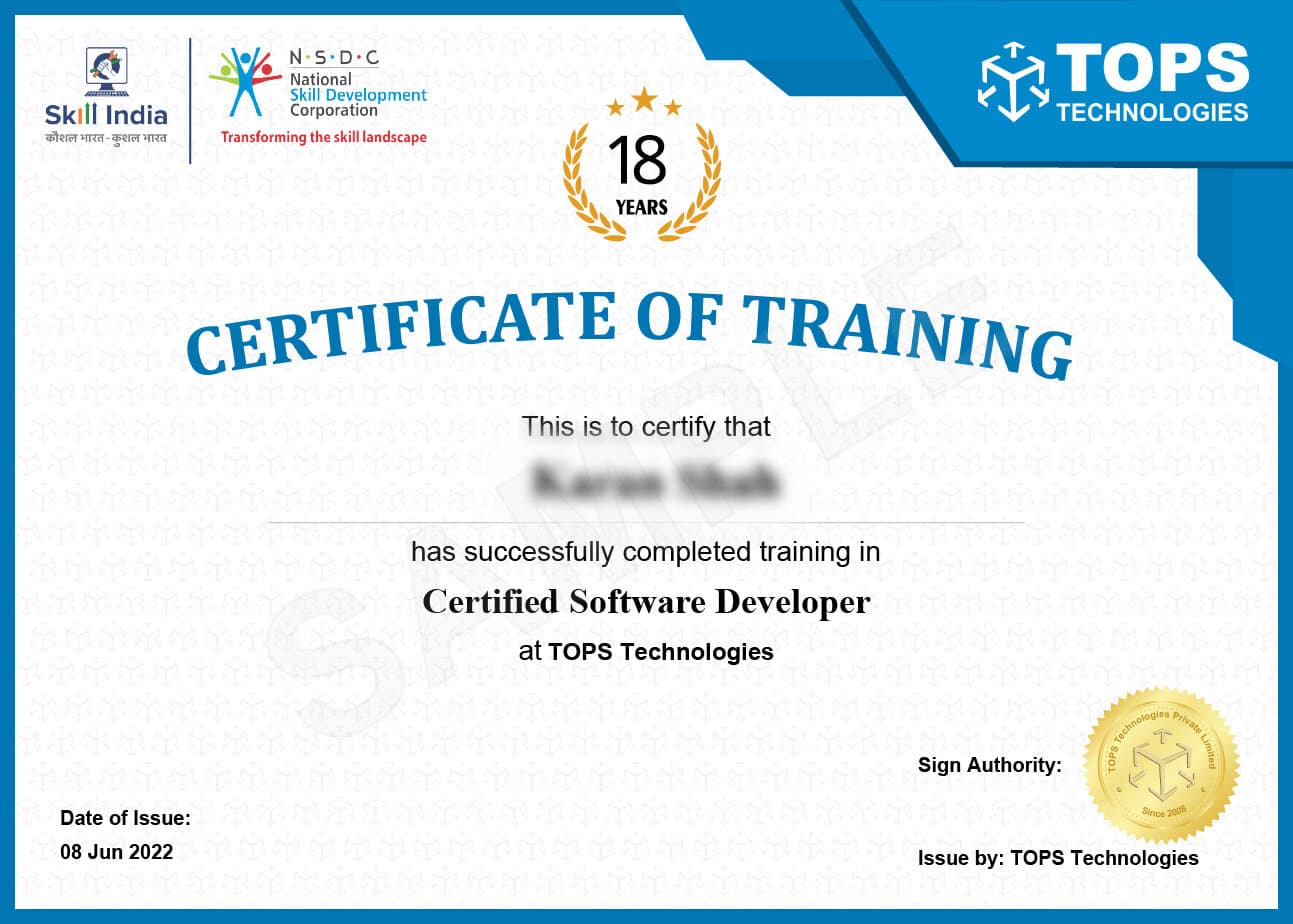
Get Training Certificate by Government
Recognized NSDC/Skill India

Certificate Demo Image
  • National Skill Development Corporation
  • Supported by the vision of PM Shri Narendra Modi
  • Certification by NSDC SkillIndia
  • Valid for all Jobs and College Training
  • International Recognition
Certificate Demo Image

Student Reviews

FAQ

Software testing courses in Ahmedabad vary a lot in terms of the amount of money that you need to shell out for them. In general, a software testing course at a private institute would cost you around a few lakhs in course fees.

TOPS Technologies  offers Software Testing Live Project Training in Ahmedabad. This is an excellent way to learn software testing and gain real-world experience. You will be working on a live project with our trainers during the training. This is an unforgettable opportunity to learn from the best and be part of a successful project.

If you are looking for a new career in the software testing industry, Ahmedabad may be the perfect place for you. There are many software testing companies located in and around the city which are always in need of testers. Here are some tips on how to get started in the field:

1. First, research which software testing companies are currently hiring in Ahmedabad. Check out job boards and websites to find listings for open positions.

2. Once you have a few companies in mind, send your resume and cover letter to these companies directly. Make sure to include your current skills and experience in testing software products.

3. Keep an eye on job listings and company websites for future updates and changes. If you have the opportunity to attend job fairs or networking events, take advantage of it!

TOPS Technologies  offers a software testing course with placement assistance in Ahmedabad. The course covers all the essential concepts of software testing and provides an opportunity to learn from experienced professionals. This is designed for students who have an interest in software testing training in Ahmedabad and want to pursue a career in this field.

The salary of a software testing professional can go up to Rs 1 crore per annum based on experience, skills and qualifications.

If you are looking for intensive preparation for the software testing interview, then TOPS Technologies is the right place for you. Our experts have years of experience in the field and can help you to prepare for the most common questions asked during the interviews.

We offer an interactive course that covers topics like problem-solving, software testing tools, and interview tips.

A software testing course in Ahmedabad can provide students with the skills and qualities needed to become successful software testers. Here are the specific skills you need to be successful as a software tester.

Programming Skills

To be a successful software tester, you'll need some programming experience. However, not all software testing will require coding. For example, some tests might involve simulating user behavior or executing automated tests.

Regardless of the type of test you conduct, you'll need to have strong writing and problem solving skills. You'll also need to have a good understanding of computer systems and software. This includes knowing how software works under the hood as well as how users interact with it.

Back End Testing

One of the most important skills you'll need is back end testing. Back end testing involves testing the functionality of an application's back end (i.e., the part of the application that handles data). This includes everything from managing databases to handling user input/output (UI/UX).

Analytical skills

In order to be a successful tester, you need to be able to quickly identify problems with a program and figure out why they occur. This requires good analytical skills. 

You need to be able to break down a problem into its component parts and understand how each one contributes to the overall issue. You also need to be able to think outside the box and come up with alternative solutions when things don’t work as expected.

Selenium is a popular open-source automation tool used for testing web applications. It supports multiple browsers and programming languages like Java and Python.


Yes, this course includes both manual and automation testing modules. You'll get hands-on experience with tools like Selenium and scripting basics.

Black-box testing checks the functionality of an application without knowing its internal code. Testers focus on inputs and expected outputs based on user requirements.

White-box testing involves analyzing the internal structure, code, and logic of the software. It’s typically performed by developers during unit testing.


Regression testing ensures that new code changes haven’t affected existing functionalities. It is essential after every code update or bug fix.

UAT is the final phase where end users test the software to confirm it meets their business needs. It’s a crucial step before product release.

Yes, the course includes real-time projects, test scenarios, and assignments. This practical exposure helps you build confidence and improve your skills.


There are no strict prerequisites. A basic understanding of computers and logical thinking is enough to get started with software testing.


STLC stages are Requirement Analysis, Test Planning, Test Case Design, Test Environment Setup, Test Execution, and Test Closure. Each stage ensures quality at every step.


The defect life cycle describes the stages a bug goes through from discovery to resolution. It includes statuses like New, Assigned, Fixed, Retested, and Closed.

Interview Questions

According to the dictionary, regression is returning to a former location or situation. Regression is a term used in software to describe a feature that used to work but now does not because a developer added new code or functionality to the product.

Regression is a common problem in the software industry caused by constantly adding new features. The developers do not separate these features from the rest of the code. Instead, the new code interacts with and influences the old code differently, introducing side effects—whether or not these effects were intended—into the system.

Because of this, there is always a chance that making new changes could hurt a feature already being used. It is important to remember that even a small change can cause a drop in performance.

Regression testing is used to make sure that adding new code or changing existing code does not change how the programme behaves in a way that was not expected. It lets the tester check that the new code works well with the old code.

Human testers manually test cases and generate test reports due to manual software testing. During automated software testing, these activities are completed using automation tools such as test scripts and code. The tester takes on the end user role to evaluate how well the app works.

Static testing is a white-box methodology that advises developers to inspect their code for flaws using a checklist. Before finalising the application or programme, developers may begin static testing. The cost-effectiveness of static testing is because it covers more territory in less time than dynamic testing.

It is a typical method of assessing software in which the programme is evaluated based on how well it satisfies the organisation's needs. From the end user's perspective, the programme is evaluated as a "black box."

Manual testing has the following advantages:

It is less costly.

You get prompt and effective visual feedback.

It is a good tool for assessing more subtle changes.

This is useful for testing on the fly.

There is no requirement for testers to have a previous understanding of automation tools.

It works great for testing interface design.


The defect life cycle tracks a bug from its identification to its closure. It includes statuses like New, Assigned, Open, Fixed, Retested, Verified, and Closed. If a bug is not fixed or reproducible, it may be marked as Rejected or Deferred. Understanding this cycle helps manage issues efficiently during development.

Exploratory testing is an informal test approach where testers explore the application without predefined test cases. It relies on tester experience and creativity to identify defects. It’s especially useful in agile projects or when documentation is limited. This method helps uncover critical and hidden bugs quickly.

In Agile, testing is continuous and integrated into each sprint. Testers work closely with developers, attend daily stand-ups, and prepare test cases based on user stories. Automation and exploratory testing play key roles. Feedback is fast, and the process is adaptive to change, ensuring frequent, quality releases.

Automation in DevOps is crucial for continuous integration and delivery. Automated tests are triggered on every code commit, ensuring fast feedback and early bug detection. Tools like Jenkins, Selenium, and JUnit help maintain stability and improve release cycles. This results in higher productivity and faster deployment.

Entry criteria define the conditions that must be met before testing can begin, such as availability of test cases and test data. Exit criteria are the requirements that must be fulfilled before testing can be considered complete, like defect resolution and test coverage percentage. These ensure structured and quality-focused testing.

Latest Blogs