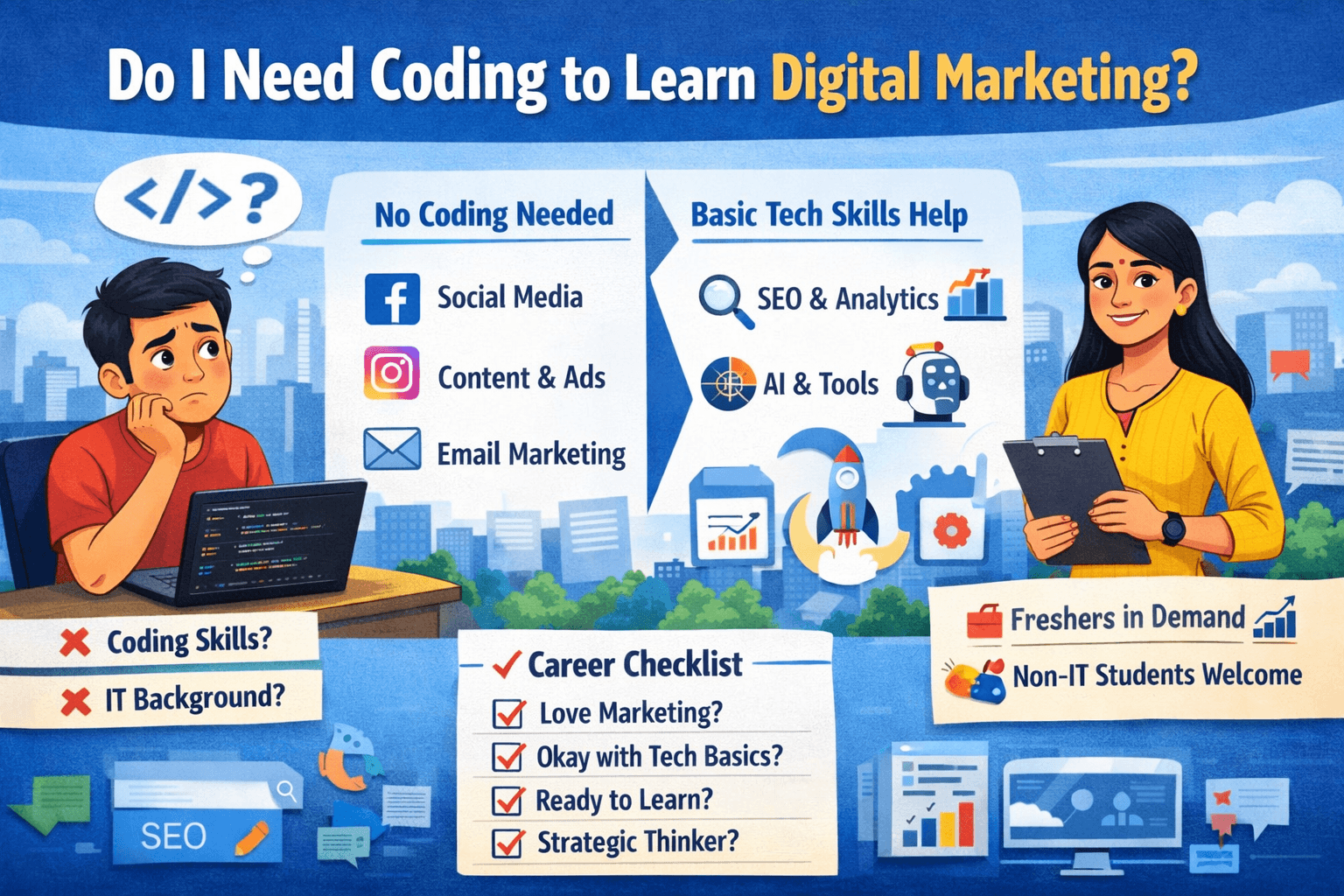
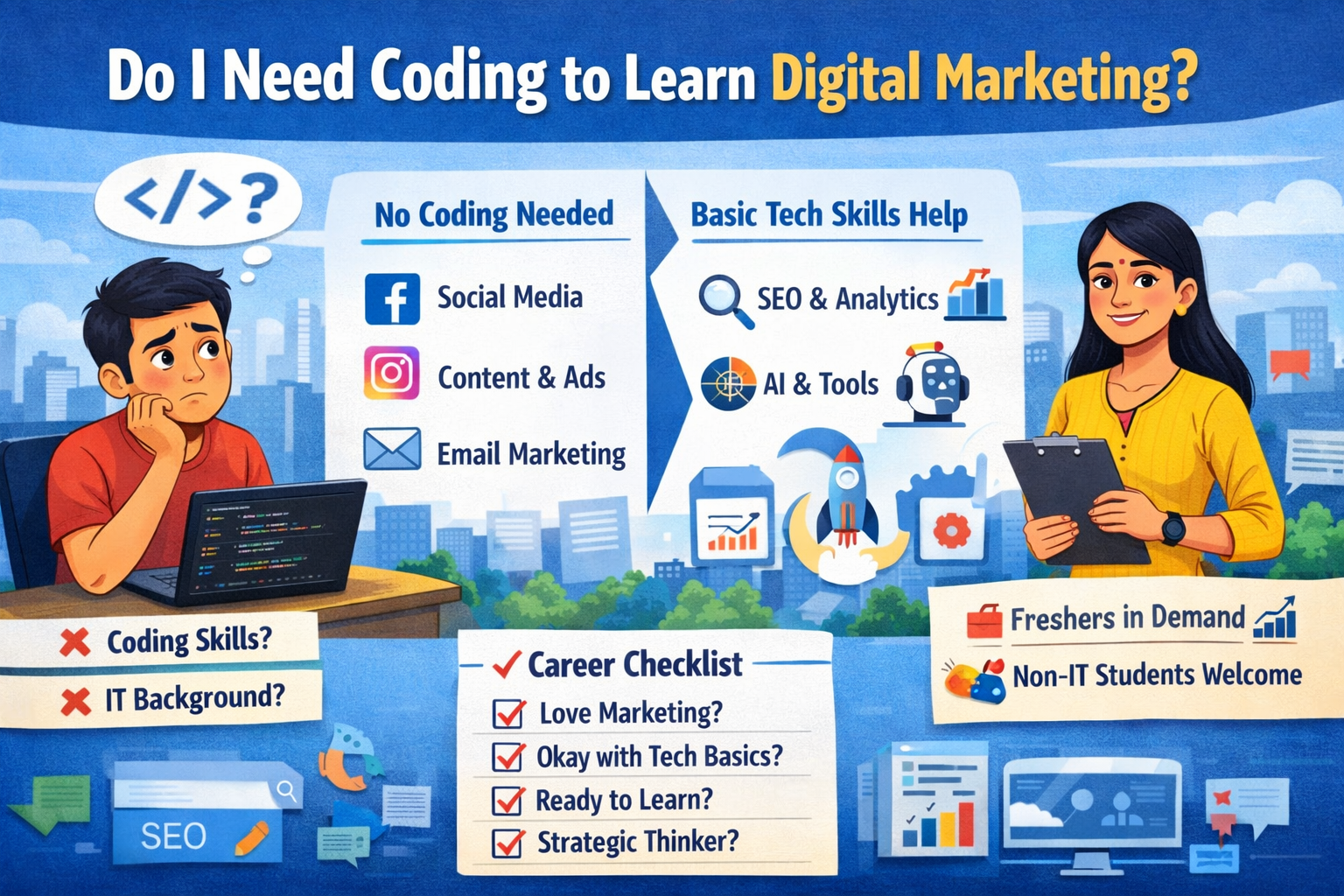
No, you do not need coding to learn digital marketing. Most digital marketing roles focus on strategy, content creation, advertising, SEO, and analytics rather than programming. While basic HTML knowledge can be helpful for SEO and tracking tasks, it is completely optional. Many successful digital marketers in India come from arts, commerce, and other non-technical backgrounds.
Understanding Digital Marketing and Coding Requirements
Digital marketing is a broad field that includes multiple specializations. The coding requirement varies significantly based on the specific role you choose. For most entry-level and mid-level positions, coding skills are neither expected nor necessary.
The confusion often arises because digital marketing involves working with websites, tools, and platforms. However, using these tools is very different from building them. Most digital marketing professionals use ready-made platforms and software that require no programming knowledge.
Digital Marketing Roles That Need Zero Coding
Several digital marketing roles require absolutely no coding knowledge:
Content Marketing: Creating blog posts, articles, social media content, videos, and email campaigns focuses entirely on communication skills, creativity, and understanding audience needs. No coding is involved.
Social Media Marketing: Managing Facebook, Instagram, LinkedIn, Twitter, and other platforms requires content strategy, community engagement, and analytics understanding. All tasks are performed through user-friendly interfaces.
Pay-Per-Click Advertising (PPC): Running Google Ads, Facebook Ads, and other paid campaigns involves strategy, budgeting, targeting, and performance analysis. Platforms provide visual dashboards requiring no code.
Email Marketing: Designing campaigns, writing copy, segmenting audiences, and tracking metrics happen through drag-and-drop tools like Mailchimp or HubSpot.
Digital Marketing Strategy: Planning campaigns, analyzing competitors, setting KPIs, and managing teams requires business thinking and analytical skills, not programming.
"According to Nikul Gandhi, senior industry trainer at TOPS Technologies, the majority of digital marketing freshers we train come from BA, BCom, and BBA backgrounds. They successfully transition into roles like content marketing, social media management, and paid advertising without writing a single line of code. The focus should be on understanding customer behavior and campaign strategy."
Roles Where Basic Coding Knowledge Helps (But Is Not Required)
Some digital marketing areas benefit from basic technical understanding, but even here, coding is not mandatory:
Search Engine Optimization (SEO): SEO specialists sometimes need to read HTML to optimize title tags, meta descriptions, and structured data. However, many SEO professionals work successfully by understanding concepts without writing code themselves. They collaborate with developers when needed.
Marketing Analytics: Analyzing data from Google Analytics, social media insights, and campaign reports requires analytical thinking. While advanced analysts may use tools like Google Tag Manager that involve code snippets, beginners start with basic reporting interfaces.
Email Automation: Setting up automated email sequences and workflows uses visual builders in most platforms. Understanding basic logic helps, but programming is not necessary.
In these roles, if you understand what needs to be done technically, you can guide a developer or use no-code tools to implement it.
Can Non-IT Students Learn Digital Marketing Easily?
Yes, non-IT students can learn digital marketing very easily. In fact, digital marketing values skills that non-technical students often possess naturally:
Communication Skills: Arts and humanities students typically excel at writing, storytelling, and audience engagement—core digital marketing competencies.
Business Understanding: Commerce and management students understand customer behavior, sales funnels, and ROI concepts, which directly apply to marketing campaigns.
Creativity: Students from creative backgrounds bring fresh perspectives to content creation, campaign ideation, and brand messaging.
Analytical Thinking: Any background can develop the analytical skills needed to interpret marketing data and make strategic decisions.
Digital marketing courses are designed assuming zero prior technical knowledge. Training focuses on platform usage, strategy development, and practical application rather than programming concepts.
What Recruiters Actually Ask About Coding in Interviews
Understanding real hiring expectations helps reduce unnecessary anxiety:
For most digital marketing fresher positions, recruiters do not ask coding questions. Instead, they focus on:
Platform Familiarity: Have you used Google Ads, Facebook Business Manager, or SEO tools? Can you navigate these platforms?
Campaign Thinking: How would you plan a campaign for a specific product? What metrics would you track?
Content Skills: Can you write compelling ad copy? Do you understand what makes content engaging?
Analytical Ability: Can you interpret campaign data and suggest improvements?
For SEO-focused roles, recruiters might ask if you understand basic HTML structure (like knowing what a title tag or heading tag is), but they rarely expect you to write code from scratch. They want to know if you can identify technical issues and communicate them to developers.
The emphasis is always on strategic thinking, creativity, and results orientation rather than technical programming ability.
When Does Coding Actually Become Useful in Digital Marketing?
While not required, basic coding knowledge provides advantages in specific situations:
Career Advancement: Senior roles like Marketing Technology Manager or Growth Hacker sometimes require technical skills to integrate tools, automate workflows, or customize solutions.
Faster Problem-Solving: Understanding HTML and CSS lets you make quick website changes without waiting for developer availability.
Better Developer Collaboration: Knowing basic coding language helps you communicate more effectively with technical teams.
Tool Customization: Some analytics and automation tools allow custom scripts for advanced features.
However, these advantages come into play after you have established yourself in digital marketing. Beginners should focus on core marketing skills first and consider learning basic coding later if their career path requires it.
SEO vs Ads vs Content: Where Coding Helps and Where It Doesn't
Different digital marketing domains have varying technical requirements:
Search Engine Optimization (SEO): Basic HTML understanding helps with on-page optimization. Knowing how to read code allows you to spot technical issues. However, many successful SEO professionals rely on tools like Screaming Frog, SEMrush, and Yoast that require no coding. Technical SEO specialists who handle complex website issues may need more coding knowledge, but content SEO and local SEO roles do not.
Paid Advertising (Google Ads, Facebook Ads): Zero coding required. All tasks happen through visual interfaces. Success depends on targeting strategy, budget management, ad copywriting, and performance optimization.
Content Marketing: Absolutely no coding needed. Focus is entirely on research, writing, storytelling, audience understanding, and content distribution.
Social Media Marketing: No coding involved. Platform knowledge, content creation, community management, and engagement strategies matter most.
Email Marketing: Drag-and-drop builders handle design. Focus is on segmentation, personalization, and conversion optimization.
Analytics and Reporting: Beginners use built-in reporting features. Advanced analysts might use Google Tag Manager or custom tracking, which involves code snippets, but extensive programming is not required.
How AI Tools Are Reducing the Need for Coding in Digital Marketing
Artificial intelligence is making digital marketing even more accessible for non-technical professionals:
Automated Code Generation: AI tools can now generate meta descriptions, schema markup, and basic HTML elements based on simple text instructions.
No-Code Platforms: Website builders like Wix, Shopify, and WordPress with page builders allow complete website management without coding.
Smart Analytics: AI-powered analytics platforms automatically identify trends, anomalies, and insights without requiring manual data manipulation.
Content Creation: AI writing assistants help create and optimize content, reducing the technical barrier to entry.
Automated Testing: A/B testing platforms automatically split traffic and determine winning variations without coding knowledge.
This trend means that technical skills are becoming less important while strategic thinking, creativity, and understanding human behavior are becoming more valuable in digital marketing careers.
Learning Path for Students from Non-Technical Backgrounds
If you are from arts, commerce, or any non-IT background, follow this practical learning approach:
Start with Fundamentals: Understand marketing concepts, consumer behavior, and how digital channels work. Focus on strategy before tools.
Choose One Specialization Initially: Begin with content marketing, social media, or paid advertising. Avoid trying to learn everything simultaneously.
Learn Through Practical Projects: Create a blog, manage social media for a small business, or run a small ad campaign. Hands-on experience builds confidence faster than theory.
Master Platform Interfaces: Spend time exploring Google Ads, Facebook Business Manager, Google Analytics, and SEO tools. Familiarity with dashboards and settings is more valuable than coding.
Develop Analytical Thinking: Learn to interpret data, identify patterns, and make data-driven decisions. This skill applies across all digital marketing roles.
Build Communication Skills: Practice writing ad copy, social media posts, and email campaigns. Clear communication is essential for marketing success.
Consider Basic HTML Later: After you are comfortable with core marketing skills, you can optionally learn basic HTML and CSS if you want to specialize in SEO or email template customization. This is an enhancement, not a requirement.
Reality Check: Course Marketing vs Job Requirements
Many students worry about coding because of confusing information from various sources:
Course Advertisements: Some digital marketing courses emphasize technical modules to appear comprehensive. This creates the impression that coding is essential when it actually is not for most roles.
Job Descriptions: Companies sometimes list HTML or CSS as "preferred" skills in job postings. This usually means "nice to have if you know it" rather than "mandatory requirement." Many candidates without these skills still get hired based on their marketing abilities.
Influencer Content: Some digital marketing influencers come from technical backgrounds and share their experience as universal advice, creating confusion for non-technical students.
The reality is that Indian companies hiring digital marketing freshers prioritize campaign thinking, platform knowledge, communication skills, and willingness to learn over coding ability. Focus on demonstrating these competencies during interviews rather than worrying about programming gaps.
Success Stories: Non-Technical Backgrounds in Digital Marketing
Many successful digital marketers in India come from diverse educational backgrounds:
Literature graduates become content marketing managers, creating brand stories and engagement strategies. Commerce students transition into performance marketing roles, managing advertising budgets and ROI optimization. Psychology graduates excel in consumer behavior analysis and social media strategy. Mass communication students leverage their storytelling skills in digital campaigns.
These professionals succeed not because of technical skills but because of their understanding of people, persuasive communication, analytical thinking, and creative problem-solving abilities that digital marketing truly requires.
Common Mistakes Students Make When Starting Digital Marketing
Avoid these misconceptions when beginning your digital marketing journey:
Delaying Start Due to Coding Fears: Many students postpone learning digital marketing thinking they must learn coding first. This wastes valuable time. Start immediately with core marketing skills.
Trying to Learn All Tools at Once: Digital marketing has hundreds of tools. Focus on mastering a few essential platforms for your chosen specialization rather than superficial knowledge of many.
Theory Without Practice: Reading about digital marketing is not enough. Practical application through real projects builds actual competence.
Ignoring Soft Skills: Overemphasizing technical tools while neglecting communication, creativity, and strategic thinking limits career growth.
Following Every Trend: Digital marketing evolves rapidly, but fundamental principles remain constant. Build strong foundations before chasing every new platform or tactic.
Frequently Asked Questions
Is coding required for SEO or digital marketing jobs?
Coding is not required for most digital marketing jobs, including many SEO positions. While basic HTML knowledge helps SEO specialists with on-page optimization, it is not mandatory. Many SEO professionals use tools that handle technical aspects without coding. Content SEO, local SEO, and link building roles require zero programming. Technical SEO specialists may benefit from coding knowledge, but this is a specific specialization, not a general requirement.
Can non-IT students learn digital marketing easily?
Yes, non-IT students can learn digital marketing very easily. Digital marketing values communication skills, creativity, business understanding, and analytical thinking—skills that students from arts, commerce, and management backgrounds often possess. Courses assume no prior technical knowledge and focus on platform usage and strategy. Many successful digital marketers come from non-technical educational backgrounds.
What coding should I learn for digital marketing, if any?
If you want to learn coding for digital marketing, start with basic HTML and CSS for understanding website structure. This helps with SEO and email template work. However, this is optional enhancement, not a requirement. Most digital marketers never learn coding and succeed through platform expertise, strategy, and communication skills. If your role later requires technical skills, you can learn them gradually while working.
Is digital marketing good for arts or commerce students?
Yes, digital marketing is excellent for arts and commerce students. Arts students bring strong communication, writing, and creative skills essential for content marketing, social media, and brand storytelling. Commerce students have business understanding, analytical thinking, and customer focus valuable for campaign strategy, budget management, and ROI optimization. Both backgrounds transition smoothly into digital marketing careers without needing technical or IT knowledge.
Can I get a digital marketing job without technical skills?
Yes, you can get digital marketing jobs without technical skills. Most companies hiring for content marketing, social media management, paid advertising, and entry-level SEO positions do not require coding or programming knowledge. They prioritize platform familiarity, campaign thinking, content creation ability, and analytical skills. Technical skills may help in advancement but are not barriers to entry-level positions.
Does digital marketing involve website development work?
No, digital marketing does not typically involve website development work. Digital marketers use websites and may suggest changes, but actual development is done by web developers. Digital marketers focus on driving traffic, creating content, running campaigns, and analyzing performance. Some roles like Marketing Technology Manager might involve technical integrations, but these are specialized positions, not standard digital marketing work.
Is digital marketing harder if you don't know coding?
No, digital marketing is not harder without coding knowledge. The majority of digital marketing tasks—strategy development, content creation, campaign management, social media engagement, and performance analysis—require no programming. Learning platforms and tools is straightforward through their user interfaces. Not knowing coding does not limit your ability to succeed in most digital marketing roles. Strategic thinking and creativity matter more than technical skills.
Which digital marketing field needs coding the most?
Technical SEO is the digital marketing field that benefits most from coding knowledge, particularly HTML, CSS, and basic JavaScript understanding. Marketing automation and analytics specialists also sometimes use code for custom tracking and integrations. However, even in these fields, many professionals succeed using tools and collaborating with developers rather than coding themselves. Growth hacking roles may require technical skills, but this is a specialized career path, not mainstream digital marketing.
Will lack of coding affect salary in digital marketing?
Lack of coding does not significantly affect salary in most digital marketing roles. Salaries depend on your specialization, experience, campaign results, and strategic abilities rather than coding knowledge. Content marketers, social media managers, and paid advertising specialists earn competitive salaries without programming skills. Technical skills may provide slight advantages in specialized roles like Marketing Technology Manager, but overall career earning potential depends on marketing expertise, not coding ability.
Is digital marketing future-proof without technical skills?
Yes, digital marketing remains future-proof without technical skills. As AI and no-code tools handle more technical tasks, strategic thinking, creativity, understanding consumer behavior, and communication skills become more valuable. The future of digital marketing emphasizes human insight, brand storytelling, and customer experience—areas where technical skills are irrelevant. Continuous learning about new platforms and strategies matters more than coding knowledge for long-term career sustainability.
```