Manual Testing Course in Ahmedabad
Manual Testing Course and Get Placed in MNCs as a Manual Software Tester


Certificate Partner(s): NSDC/Skill India

- Hands on Training
- Flexible Timings
- Industry Based Training
- Expert Trainer
- Affordable Fees
- Placement Opportunities
Attend a Free Demo
Fill the details and we will call you for further guidance

Our Facts and Figures
1 Lac+
Student Placed
3000+
Companies TieUp
19+
Offices in India
50+
Industry Courses
Get 100% Job Assistance by enrolling in Certified Manual Testing Training Course
Key Highlights
Limited Students Batch
Personalised Attention
Highly Qualified Teachers
Flexible Batch Timings
Interactive Learning
Live Projects
Career Support
Job Oriented Training
Manual Testing Course Highlights
Manual Testing Course in Ahmedabad — 100% Placement Assistance + Live Projects
Build a strong career in software quality assurance with the Manual Testing Course in Ahmedabad at TOPS Technologies. This industry-focused program is designed for beginners and professionals who want practical exposure, real-time projects, and 100% Placement Assistance. Learn testing concepts in Ahmedabad with expert mentors and job-ready skills. Explore the city on Wikipedia.
TOPS Technologies has 4 training centers in Ahmedabad — CG Road, SG Road, Nikol, and Maninagar — making access easy for students across the city.
Why Choose TOPS Technologies?
- 100% Placement Assistance with dedicated placement support
- Hands-on manual testing live project training
- Flexible weekday and weekend batches
- Expert trainers with real industry experience
- Certification guidance and interview preparation
- Career guidance with mock interviews
Why This Manual Testing Course in Ahmedabad?
Ahmedabad is emerging as a strong IT and startup hub, creating high demand for skilled software testers. Enrolling in a manual testing course near me helps learners gain localized job opportunities and industry exposure. With increasing demand for QA roles, a structured manual testing full course equips you with practical testing skills, documentation knowledge, and defect lifecycle understanding needed by local companies.
Job Opportunities in Ahmedabad
After completing the Manual Testing Course in Ahmedabad, learners can explore opportunities in IT companies, software development firms, startups, and MNCs. Entry-level QA professionals can expect competitive salaries, while experienced testers can move into senior QA and lead roles. This manual testing training prepares you for real-world projects and corporate environments.
Job Designations After Completing the Course
- Manual Tester
- Software Test Engineer
- Quality Assurance Analyst
- QA Executive
- Test Analyst
- Junior QA Engineer
- Test Coordinator
- Software Quality Analyst
Who Can Enroll?
- Freshers and graduates
- IT and non-IT students
- Working professionals
- Career switchers
What to Expect From This Training
- Industry-recognized certification
- Real-world projects and case studies
- Tools and documentation exposure
- 100% Placement Assistance
- CareerFest events and hiring drives
- Resume building and mock interviews
Curriculum Overview
- Introduction to Software Testing & SDLC
- Manual Testing Concepts & Methodologies
- Test Case Design & Execution
- Defect Tracking & Reporting
- Live projects for manual testing
- Interview Preparation & Practical Labs
Placement & Career Support
TOPS Technologies offers strong placement support through JobFest, CareerFest / Campus Drive, and a dedicated Placement Cell. Students receive resume assistance, mock interviews, and corporate exposure.
Student Testimonials
“The manual testing course at TOPS helped me understand real QA processes.”
“Excellent support and guidance through manual testing classes in ahmedabad.”
“I gained confidence after completing manual testing live project training.”
“Practical learning with great mentors during manual testing training.”
Local Centers — Train at the nearest TOPS Technologies centre
TOPS Technologies CG Road
Address: TOPS House, 2, Chimanlal Girdharlal Rd, Shanti Sadan Society, Ellisbridge, Ahmedabad, Gujarat 380006
Phone: +919974755006
TOPS Technologies SG Road
Address: 102, Baleshwar Square, Iskcon Cross Rd, Sarkhej - Gandhinagar Hwy, opposite Iskcon Mandir, Ahmedabad, Gujarat 380015
Phone: +919904422211
TOPS Technologies Maninagar
Address: 401, Amruta Arcade, Maninagar Char Rasta, Lala Lajpat Rai Marg, Maninagar, Ahmedabad, Gujarat 380008
Phone: +919974863333
TOPS Technologies Nikol
Address: 401, TOPS Technologies, Hilltown Landmark, Nikol Canal Rd, Opp. Das Khaman, Nikol, Ahmedabad, Gujarat 380049
Phone: +917624007666
Advanced Course Insights
Manual testing remains a critical foundation of software quality assurance. Businesses rely on skilled testers to ensure functionality, usability, and performance. The Manual Testing Course in Ahmedabad focuses on practical testing methodologies, defect management, and industry workflows. With increasing digital transformation in India, the demand for QA professionals continues to grow. TOPS Technologies provides structured learning, expert mentorship, live projects, and 100% Placement Assistance to help learners build long-term careers in software testing.
40%
Average Salary Hike
4.5 Lacs
Highest Salary
3000+
Hiring Partners
Join Our Free Upcoming Webinar

Freelancing as a Career: Opportunities For College Students
23 May 2026, 11:00 AM
Trainer
Anjali Patel
(Sr. Technical Trainer)


AI for Designers: Create More, Stress Less
23 May 2026, 02:30 PM
Trainer
Parth Patel
(Sr. Technical Trainer)
Manual Testing Course Curriculum
Download Curriculum- Introduction to Manual Testing
- Introduction of Students
- Career in Manual Testing
- Working on Project and Assignment
- Using Lab
- Fundamentals
- What is Testing?
- Testing Activities
- Test Objectives
- Objectives and purpose
- When and Why Testing?
- When to start and stop Testing?
- 7 Key Principles of Testing
- Error, Bug, Defects, and Causes of Defects
- Quality, Risk: Types of Risks.
- Test Organization :
- (Tester, Test Leader, Test planning, QA v/s QC, Testing V/s Debugging )
- Test Development Process:
- Introduction, Test Analysis, Test Plan, Strategy, HLR, Script, Scenario, Cases, Traceability Start HLR in Practically
- Fundamental Test Process:
- STLC, Psychology of Testing
- Start TestCase in Practically
- Software Development Model:
- (V-Model and RAD)
- Software Testing Levels:
- Unit Testing, Integration Testing, System Testing, Acceptance Testing, Alpha and Beta Testing, Testing definitions as per ISTQB.
- Start Scenario (Positive / negative) Practically(Minimum 21 scenario)
- Test Design Techniques
- Dynamic Testing :
- Functional and Non Functional Testing
- Black Box Testing Techniques
- White Box Testing Techniques
- Experience-Based Testing Techniques
- Maintenance Testing
- Other Testing :
- Smoke and Sanity
- End to End, Retesting and Regression
- Positive and Negative
- Static Testing (Formal, Informal, Types of Review, Estimation Techniques)
- Start Defect Report
- Agile Testing
Attend a Free Demo
Fill the details and we will call you for further guidance
Our TOPS Training Centers in India








Course Key Features

Skills Covered

Job Roles

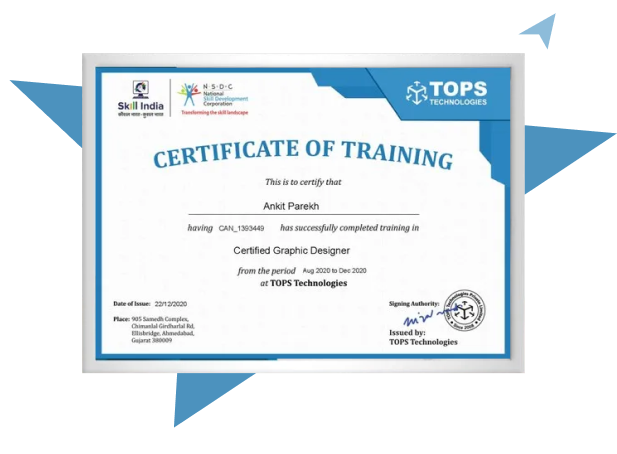
Get Training Certificate by Government
Recognized NSDC/Skill India
- National Skill Development Corporation
- Supported by the vision of PM Shri Narendra Modi
- Certification by NSDC SkillIndia
- Valid for all Jobs and College Training
- International Recognition
Student Reviews
Nandini Parikh
Manual TesterOverall, the Manual Testing course at TOPS Technologies Ahmedabad was a valuable learning experience. The comb...
Read MoreAditya Lunkad
Manual TesterI appreciated the focus on real-world testing workflows. The course explained how testers collaborate with dev...
Read MoreEsha Mukherjee
Manual TesterHands on practice during the Manual Testing training at TOPS Technologies Ahmedabad helped me understand requi...
Read MoreDanish Pathan
Manual TesterThe course curriculum was well organized and beginner friendly. Even without prior technical background, I was...
Read MoreMitali Ghosh
Manual TesterManual Testing course beginners ke liye bohot suitable hai. Step by step teaching style ki wajah se testing co...
Read MoreYashvardhan Tomar
Manual TesterI enrolled in the Manual Testing course at TOPS Technologies Ahmedabad, and it gave me confidence in identifyi...
Read MoreShubhangi Inamdar
Manual TesterThe Manual Testing course helped me build a strong foundation in quality assurance. The assignments were pract...
Read MoreRehan Mirza
Manual TesterThe trainer at TOPS Technologies Ahmedabad explained different types of testing such as functional, regression...
Read MorePallavi Deshpande
Manual TesterWhat I liked most about the Manual Testing course was the hands-on approach. Writing and executing test cases...
Read MoreVihaan Purohit
Manual TesterI had a very positive learning experience during the Manual Testing training at TOPS Technologies Ahmedabad. T...
Read MoreTasneem Rangwala
Manual TesterThe Manual Testing course at TOPS Technologies Ahmedabad provided a clear understanding of software testing fu...
Read MoreNikhil Wagh
Manual TesterMaine Manual Testing course TOPS Technologies Ahmedabad se join kiya, aur training kaafi practical rahi. SDLC,...
Read MoreFAQ
Entry criteria define the conditions required to begin testing, such as availability of test data. Exit criteria outline when testing can stop, like completing test cases or achieving a defect threshold.
Smoke testing is a quick initial test to check if the major functionalities of an application are working. It ensures the build is stable enough for further testing.
Sanity testing verifies that specific functionality or bug fixes work after minor changes. It is narrow in scope and conducted before deeper regression testing.
Regression testing ensures that new code changes have not affected existing functionality. It’s repeated after every update or bug fix to maintain software stability.
Severity indicates the impact of a defect on the application, while priority reflects how soon it should be fixed. A high-severity issue may not always be high priority.
BVA is a test design technique that focuses on values at the edges of input ranges. Testing these values helps uncover common input-related errors.
Equivalence partitioning divides input data into valid and invalid sets where each set represents similar behavior. One test case from each group is enough for coverage.
White box testing checks internal code logic and paths, while black box testing validates external behavior without knowledge of the code structure.
UAT is the final testing phase where end-users verify the software meets their business needs. It ensures readiness for production use.
Ad-hoc testing is informal and unstructured, performed without planning or documentation. It helps discover unexpected issues through random testing.
Interview Questions
Exploratory testing is a simultaneous learning and testing activity where testers explore the application without predefined test cases. It’s useful when documentation is missing or time is limited, as it helps uncover unexpected issues quickly.
Functional testing validates the features and operations of the software based on requirements, such as login, search, or payment functionality. Non-functional testing assesses aspects like performance, usability, and reliability that affect user experience.
I ensure complete coverage by mapping test cases to requirements using a traceability matrix. I also conduct peer reviews, consider boundary and edge cases, and validate both positive and negative scenarios for thorough testing.
A test closure report is a formal document summarizing all testing activities. It includes metrics like test case execution, defect status, coverage reports, and lessons learned. It helps stakeholders assess testing effectiveness and project readiness.
I maintain flexible and modular test cases to adapt to changes quickly. Communication with developers and regular sync-ups ensure I stay updated. I also maintain a changelog and revise affected test cases promptly.
Smoke testing checks the basic functionality of an application after a new build to ensure it’s stable for further testing. Sanity testing is a focused check to verify specific functionality after bug fixes or minor changes.
Test data is crucial for simulating real-world scenarios during testing. It helps validate input fields, data processing, and output accuracy. Proper test data ensures that the application behaves correctly under various conditions.
Defects are logged in a tracking tool like Jira or Bugzilla with details such as steps to reproduce, screenshots, severity, priority, and environment. A well-documented bug report helps developers resolve issues efficiently.
Severity is based on the impact on application functionality—critical, major, or minor. Priority is set according to how urgently the defect needs fixing. High-severity and high-priority bugs are addressed first.
Compatibility testing ensures that the application works as expected across different browsers, devices, operating systems, and network environments. It helps identify UI or functional discrepancies due to platform variations.